

The Queit War Between What You Know and What You Do
Ever know in your heart something is wrong, but you follow the crowd anyway? This article explores what may take place over time if you never follow your own sense of direction, your own mind, or your own heart and do the right thing. Do what you would want others to do unto you.
SELF-AWARENESSSELF-REFLECTION & INNER WORKMENTAL CLARITY & COGNITIVE MASTERYDISCERNMENT & BELIEFMINDSET & AWARENESS


June 1, 2026.
Mood: Self-Atonement. "Much ado about nothing" takes new form.
Attitude: Change is inevitable and should be faced with bravery, never ignored.
We do better because you KNOW BETTER, Not because you are better than the next person. WAKE UP!
Introduction
There comes a time when the excuses don't cut it.
Not that life hasn't been complicated. Of course complications can, and some do cause stagnation, and circumstances that are, in fact, just HARD!
But, under all those explanations, long, drawn-out stories, and excuses, you know.
You know what needs to be changed.
You've been thinking about it. Looked at it. You've talked yourself through it. Perhaps you've even promised yourself this time will be different.
And yet here you are.
Standing before the same lesson.
Faced with the same choice.
Standing again at the same crossroad, meeting the same version of yourself.
Unchanged.
There is a certain honesty I think you need in times like these. It’s not the honesty that points outward but the kind that turns inward and asks a harder question:
What am I still not seeing?
Could be the fact that you are still looking at the same person you were 30 years ago. That, right there... is what you may not be seeing.
When you are stuck, not growing, not becoming, or evolving, it indicates something is wrong.
We all go through change differently. But avoiding change altogether was never a thing.
Announcing you are still who you have ALWAYS been and that you will NEVER change, is avoidant.
It's amazing that people claim they are the best when they are not growing, not shedding certain mindsets, and not learning new lessons—life's lessons -- is a thing to be honored, admired, praised, or glorified, which is actually misunderstood.
Encouraging others to be the same their entire existence is miseducation.
In order to grow as a culture and civilization, it starts at the individual mind. But what happens when you have a culture encumbered by never changing?
You get a bunch of stuck individuals. Trying to be the same. Identity starts to blur. Lines of individuality, authenticity, and originality—you know, what it takes to just be yourself—are slowly forgotten.
You start to get pick-mes. An easily influenced people. People with no sense of direction. Easily misled. Afraid. Naked, scared, and afraid of making their own decisions and standing out from the crowd.
Self-atonement isn’t about guilt. It's not about shame. It's not about beating yourself up over what you could have done differently.
It’s about taking responsibility for what you know now.
For change is inevitable. Life moves on, with or without us accepting it. The question is, do we move with it or waste our energy playing at the old way, still fitting it?
Today I want to talk about that space.
Not the space between where you are and where you want to be. That conversation gets a lot of mileage.
I wish to discuss the disconnect between knowing and doing.
The space in which insight waits for courage.
Where awareness is asked to become action.
Because if you've ever found yourself saying "I know better" while watching yourself do the very thing you know no longer serves you, this conversation is for you.
It Starts Before You Name It
Cognitive dissonance is a term that sounds clinical. Academic. Like something that belongs in a psychology textbook, not in your chest at 2am when you're replaying a conversation you swore you'd handle differently this time.
But that's exactly where it lives. In the body. In the friction between what you believe about yourself and what you just watched yourself do.
You believe you're growth-oriented. And you just avoided the conversation—again.
You believe you've done the work. And the same pattern fired before you could catch it.
You believe you're ready to move differently. And the moment pressure arrived, you moved exactly like you always have.
That contradiction isn't a character flaw. It's the signal that something inside you is still running an older program—one that hasn't been updated to match who you're becoming.
The dissonance is real. The discomfort is real. What tends to go unexamined is why we choose — often unconsciously — to stay in it rather than close it.
The Real Reason You're Not Moving
We like to blame resistance on fear. Fear of failure, fear of the unknown, fear of getting it wrong. And yes — those are real. But I think we stop the analysis too early when we land there, because fear is usually protecting something.
What is the resistance actually guarding?
Sometimes it's protecting an identity.
The behavior you need to change isn't just a behavior. It's a story you've been telling about who you are. The person who holds it together. The one who pushes through. The one who doesn't need help. The one who already has the answers. When the change you need requires you to become someone different than that story — the resistance isn't laziness. It's the psyche doing what it was designed to do: protect the self it knows.
Sometimes it's protecting a comfort that masquerades as stability.
There's a version of staying stuck that feels like groundedness. The familiar pattern, even when it's painful, is known. The new behavior — even when it's clearly better — is uncertain. And the nervous system, at its most basic, prefers a known pain to an unknown possibility. Understanding this about yourself isn't defeat. It's the beginning of working with your wiring instead of against it.
Sometimes it's protecting you from having to grieve.
Change requires letting go. Not just of behaviors — but of the version of you who needed those behaviors. The one who armor-plated herself with control because being soft once cost her something. The one who people-pleased his way through rooms because approval felt like safety. Moving forward sometimes means sitting with the loss of who you had to be before you knew better. That grief is real. And it deserves acknowledgment before it can release its grip.
Resistance isn't the enemy. It's the last conversation the old version of you is asking you to have before you move on.
What Keeps the Loop Running
The part that is not talked about enough is that awareness can actually make the loop worse in itself.
That’s when shame gets in when you see the pattern clearly and you can’t move it. And shame is the most effective, quietest way to maintain the status quo. It does not declare itself. And it makes the gap seem like evidence of something very wrong with you, not something structurally missing from your process.
You knew this for years. Why haven't you fixed it? What's wrong with you ?
Does that ring a bell? That inner voice is not pumping you up. It's a ballast. Because when the gap becomes evidence of unworthiness instead of a design problem with a design solution, then the energy that could go toward change goes toward managing the shame.”
The loop looks like this: you see what needs to change → you don't change it → the awareness of not changing creates shame → the shame creates avoidance → the avoidance sustains the pattern → you see what needs to change.
Awareness without self-compassion doesn’t bridge the gap. It adorns it.
Breaking the cycle begins with not trying harder. It interrupts the shame story long enough to ask a different question, not “what’s wrong with me?” but “what is this pattern still doing for me that I haven’t found another way to meet?”
The Body Knows Before the Mind Admits It
I want to bring something in here that we don’t talk about enough in personal development spaces – the somatic layer of this one.
Your body has been doing this for longer than your conscious mind has known about it. That tension before a certain kind of conversation is about to happen. The way your energy closes around certain decisions. The exhaustion that comes when you’ve been playing a version of yourself that no longer fits.
They are not accidental. They're just data. The body is often living in the gap, absorbing the cost of the dissonance while the mind is still negotiating if the change is truly necessary.
You are in that tension, the instinct is to push through it cognitively. Think of a way out. But cognitive dissonance isn’t really a problem of thinking. It's a regulatory problem. We need to involve the body in the process, not just the mind.”
That’s what a regulation practice is about. Not peace for peace's sake, but the physiological conditions under which real change is possible.
Before your body can move differently it has to feel safe enough to move at all. The quiet before the day starts. Take a breath before the call. The deliberate pause between stimulus and response. This is not a luxury They are the real change mechanism at somatic level.
You can't think your way out of a pattern your body still has. First regulate. Then make a choice.
So How Do You Actually Move?
I’m not going to give you a 5-step framework. Because frameworks may not be the MOST useful method in this case.
This work is too personal for a generic sequence.
Here's what I'll offer:
Be specific. No theme. Don't call the theme; call the behavior.
Not “I need to be more present,” but “I’m picking up my phone within three minutes of sitting down with my kids.”
The more specific the behavior, the more specific the intervention. Themes make us turn.
Behaviors can be changed.
Ask what is the behavior avoiding. Sit with this one. There is a pattern here; it is not random; its functional.
It’s satisfying a need. It’s satisfying it badly, but it’s satisfying a need. You'll keep pulling the weed without ever touching the root until you see what need it's filling.
Design an intervention, not a solution. You don't need to know everything before you take a step. What you need is a small structural change between the trigger and the old response. Stop. A question? A gasp. A different physical place. Repetition, not revelation, changes the brain.
Quit making yourself do this alone. Self-awareness is a private matter. Behavioral change is rare. An accountability structure—a person, a practice, or an external commitment—is not a crutch. It’s a design requirement. We weren't designed to hold ourselves accountable to our own growth alone.
Have some compassion for the you who needed the pattern. What you’re trying to change was once a solution. It worked when you needed it to work. Letting it go with contempt is to not honor the intelligence of the self that built it. To move forward with grace is to say, "I did what I knew how to do with what I had and now I have more."
You're not trying to eliminate who you were. You're integrating the wisdom of who you've become.
Sit With This
If this entry struck a real place for you, here are a few questions worth taking into your journal — or just into the quiet of your morning:
What is the particular behavior (not theme) I keep coming back to?
What identity or need is this behavior protecting?
Where do I feel in my body the dissonance of knowing and not moving?
If I did change this, what would that say about me?
What can I build as an intervention between the trigger and the old response?
You don’t need to have the answers. Sitting with the right questions is already progress.
A Final Word
The gap between knowing and doing is not evidence that you're broken.
It's evidence that you're human and that the work is real—not performative. The people who talk the most about growth and do the least of it are the ones who've confused awareness with action. You're past that. You're in the harder part.
The harder part is where the actual transformation lives.
Keep going.
Coherence happens when what you know, what you feel, what you say, and what you do finally occupy the same room at the same time.
That's not a destination. It's a practice.
And practice takes time.
Time helps you pay attention to what you may need to change within yourself.
Want to go deeper?
Subscribe to Master'D Life → CLICK TO SUBSCRIBE
HoneyDew Bett'R | The Bett'R Days Diary | Growing through what we go through. honeydewbetter.com
The Pattern Isn't New
This gap has been a problem for human beings long before psychology had a name for it.
The ancient philosophers saw it. It was warned about in spiritual traditions. “Civilizations have risen and fallen over it.”
The Greeks had a word for it: akrasia, acting against your better judgement. Someone knew what to do and decided to do something different. Not that they were not intelligent, knowledge was not enough to overcome habit, emotion, desire, or fear.
Marcus Aurelius wrote a lot about the difficulty of reconciling thought and action. Across the world, religious traditions developed disciplines, rituals, and daily practices not just to teach wisdom, but to help people embody it.
Something important is suggested by history: information has never been the biggest challenge to humanity. Has integration.
The difficulty has not been knowing what is right. The problem has always been turning into the kind of person who can do it.
Perhaps that is why the same lesson is learned by every generation. Awareness opens the door. And practice is what walks through it.


Why Habit Loops Win
The brain is more interested in efficiency than transformation, which is one reason that change feels hard.
Neuroscientists think of habits as loops: Cue –> Response –> Reward
Cue to appear.
The behavior is:
The nervous system gets some sort of reward – comfort, certainty, distraction, validation, relief, or control.
Eventually the brain stops asking if the behavior is useful and starts assuming it is necessary.
That’s why insight alone can be a pain. You might be consciously recognizing a pattern while your nervous system is still getting a reward for repeating it.
The people-pleaser gets instant approval.
The overworker is temporarily important.
The avoider gets a temporary relief.
The controller has a momentary certainty.
Doesn't have to be healthy. It must be known.
That's when a healthier response starts to yield a reward the nervous system learns to trust, and sustainable change takes hold. That’s why repetition is more important than motivation. It all starts with motivation. Repetition rewires it .
Coherence: When Everything Finally Meets
A lot of people think growth is about acquiring knowledge.
I don't think that is the point.
I think the idea is coherent.
Coherence is when what you believe, what you feel, what you say, and what you do stop fighting with each other.
Most of the inner conflict is dissociation.
The mind says something.
The feelings tug another way.
The body responds to an old memory.
It's a known pattern of behavior.
And the result is friction.
Coherence reduces friction.
Not because life gets easier but because there is less energy wasted on contradictions.
The coherent person is not flawless.
They just don’t have to negotiate internally as much.
They make decisions based on their values.
Their behaviors are justified by their decisions.
Their actions confirm who they are.
Their purpose is supported by their identity.
And then everything goes in the same direction.
That alignment doesn’t happen overnight. It is built from thousands of small moments when awareness becomes action, and action becomes character.
The gap is closing one decision at a time.


By kylie De Guia On UnSplash

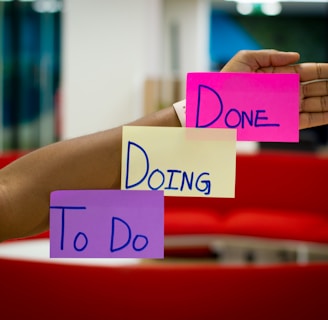
By Eden Constantino On UnSplash
By Vadim Bogulov On Unsplash
By Jon Tyson On Unsplash
By Daniel Clay On Unsplash
By 愚木混株 Yumu On Unsplash
By Paweł Bukowski On Unsplash
By Wesley Tingey On Unsplash
By Ch_pski On Unsplash

