

The Quiet War Between What You Know and What You Do: Why Awareness Alone Doesn’t Create Change
A contemplative exploration of the internal gap between awareness and action—why do people continue to repeat behaviors they already know, and how do identity, emotional conditioning, shame, and nervous system patterns quietly support the disconnect between knowing and doing.
MENTAL CLARITY & COGNITIVE MASTERYEMOTIONAL MASTERYMINDSET & AWARENESSPERSONAL GROWTHCOGNITIVE DISSONANCESELF-REFLECTION & INNER WORK
May 5, 2026.
Mood: Quietly reflective. Honest. A little confronting.
Attitude: When you know better, HoneyDew Bett'R 😁😉
You've had the conversation with yourself.
Probably more than once.
You know what needs to change. You've named it, analyzed it, maybe even journaled about it.
And still, here you are.
Same pattern. Different day.
I want to talk about that gap.
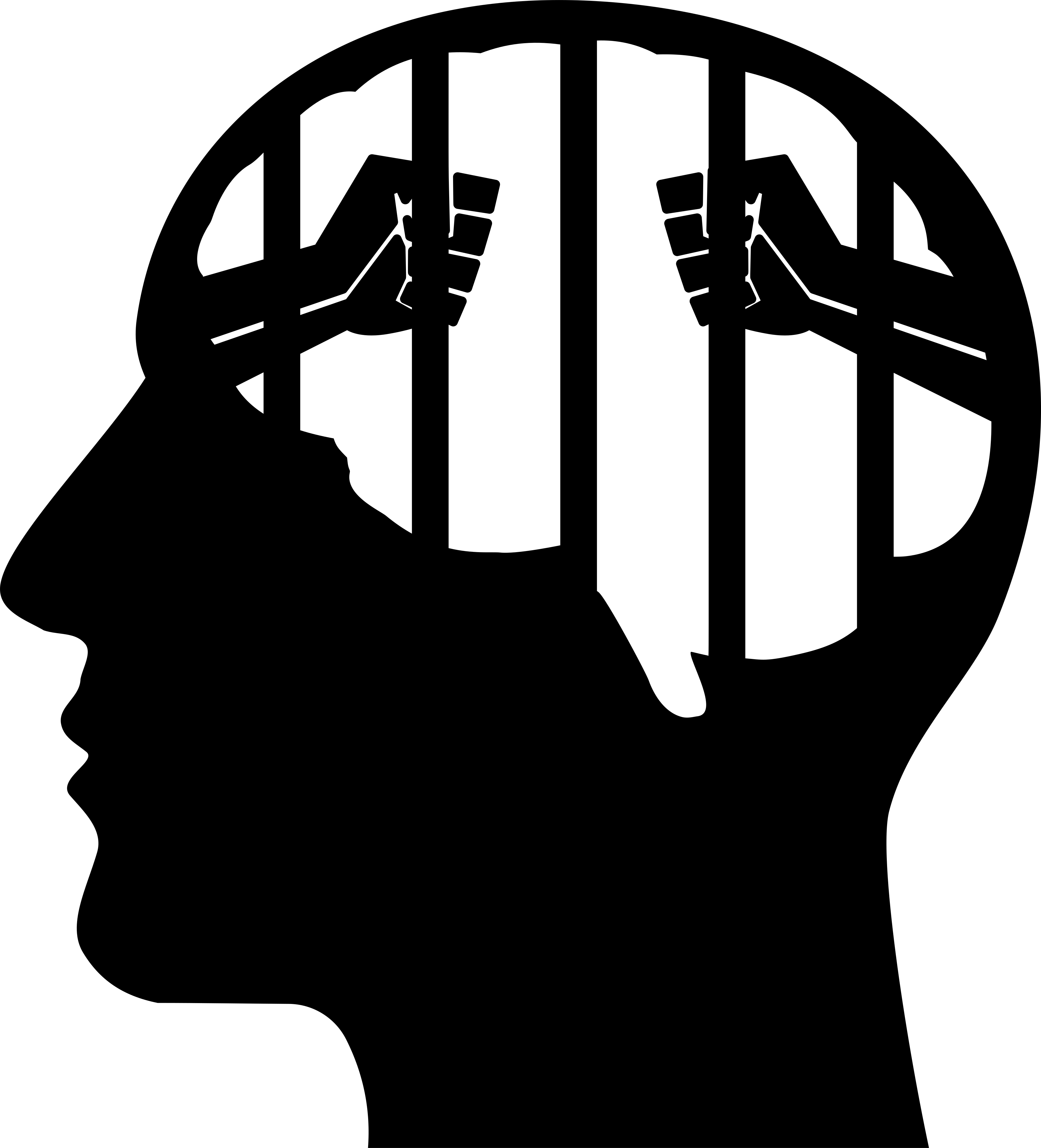
Not the one between where you are and where you want to be — that one gets plenty of airtime. I want to talk about the one that lives right in the middle of your awareness. The gap between knowing and doing. The place where insight goes to sit down and never get back up.
Because if you've ever found yourself saying, "I know better" while watching yourself do the thing you know better than to do — this one is for you.
The leadership layer of this same pattern was explored in this week’s Executive Composure Brief, where the focus shifts from internal resistance to structural leadership design.
It Starts Before You Name It
Cognitive Dissonance Isn’t Just Psychological — It’s Felt
Cognitive Dissonance is a term that may sound clinical. Academic. Like something that belongs in a psychology textbook — not in your chest at 2am when you're replaying a conversation you swore, you'd handle differently this time.
But that's exactly where it lives.
In the body. In the friction between what you believe about yourself and what you just watched yourself do.
You believe you're growth-oriented. And you just avoided the conversation — again.
You believe you've done the work. And the same pattern fired before you could catch it.
You believe you're ready to move differently. And the moment pressure arrived, you moved exactly like you always have.
That contradiction isn't a character flaw. It's the signal that something inside you is still running an older program — one that hasn't been updated to match who you're becoming.
The dissonance is real. The discomfort is real.
What tends to go unexamined is why we choose — often unconsciously — to stay in it rather than close it.
For a deeper understanding of the psychology behind cognitive dissonance, the American Psychological Association overview offers a strong foundational breakdown.
The Real Reason You’re Not Moving
We like to blame resistance on fear.
Fear of failure. Fear of uncertainty. Fear of getting it wrong.
And yes — those fears are real.
But fear is usually protecting something deeper.
🔒 Identity Protection
The behavior you need to change isn't always just a behavior.
Sometimes it's a story you've been telling about who you are.
The one who holds it together. The one who pushes through. The one who doesn't need help. The one who already has the answers.
When the change you need requires you to become someone different than that story — the resistance isn't laziness.
It's the psyche doing what it was designed to do: protect the self it knows.
⚖️ Familiar Pain Can Feel Safer Than New Possibility
There's a version of staying stuck that feels like groundedness.
The familiar pattern, even when it's painful, is known. The new behavior — even when it's clearly healthier — is uncertain.
And the nervous system, at its most basic level, often prefers a familiar discomfort over an unfamiliar possibility.
Understanding this about yourself isn't defeat. It's the beginning of working with your wiring instead of constantly fighting against it.
🕊 Sometimes Resistance Is Protecting Grief
Change requires letting go.
Not just of behaviors — but of the version of you who needed those behaviors.
The one who armor-plated herself with control because softness once cost her something. The one who people-pleased his way through rooms because approval felt like safety.
Moving forward sometimes means grieving who you had to become before you knew better.
That grief is real. And it deserves acknowledgment before it can release its grip.
Resistance isn't the enemy. It's the last conversation the old version of you is asking you to have before you move on.
What Keeps the Loop Running
😶 Shame Quietly Turns Awareness Into Stagnation
Here's the part that doesn't get talked about enough:
Awareness, on its own, can actually make the loop worse.
When you see the pattern clearly and still can't move it — shame enters.
And shame is one of the quietest, most effective mechanisms for keeping things exactly as they are.
It doesn't announce itself. It just makes the gap feel like evidence of something fundamentally wrong with you rather than something structurally missing in your process.
You've known this for years. Why haven't you fixed it yet? What's wrong with you?
Sound familiar?
That internal voice isn't motivating you. It's anchoring you.
Because when the gap becomes evidence of unworthiness rather than a design problem with a design solution — the energy that could go toward change goes toward managing the shame instead.
The loop runs like this:
awareness → inaction → shame → avoidance → repetition → awareness
And then the cycle starts again.
Awareness without self-compassion doesn't close the gap. It decorates it. Breaking the loop doesn't start with trying harder.
It starts with interrupting the shame narrative long enough to ask a different question:
What is this pattern still doing for me that I haven't yet found another way to meet?
This same pattern also appears at the systems level — where environments quietly reinforce staying the same even when change is needed. That systems perspective was explored in this week’s Power Tower article.
The Body Knows Before the Mind Admits It
🌿 The Somatic Layer of Change
I want to bring something in here that we don't talk about enough in personal development spaces:
The body has been tracking this pattern longer than your conscious mind has.
The tension that arrives before a certain conversation. The way your energy contracts around specific decisions. The fatigue that settles in when you've been performing a version of yourself that doesn't fit anymore.
These aren't incidental. They're data.
The body is often living in the gap — absorbing the cost of the dissonance — while the mind is still negotiating whether the change is really necessary.
When you're in that tension, the instinct is to push through it cognitively. To think your way to resolution.
But cognitive dissonance isn't primarily a thinking problem.
It's a regulation problem.
The body needs to be brought into the process — not just the mind.
Research surrounding the nervous system response to stress continues to show how deeply emotional and physiological responses shape behavioral patterns.
You can't think your way out of a pattern your body is still holding. Regulate first. Then decide.
🧘🏽 Regulation Is the Bridge Between Insight and Action
This is what a regulation practice is actually for.
Not peace for its own sake — but the physiological conditions under which genuine change becomes possible.
Stillness before the day begins. Breath before the decision. The intentional pause between stimulus and response.
These aren't luxuries. They are the actual mechanism of change at the somatic level.
Before you can move differently, the body has to feel safe enough to move at all.
Internal regulation and external structure often work together more closely than most people realize.
Key Takeaways
Awareness does not automatically create change
Resistance often protects identity, emotional familiarity, or safety
Shame reinforces behavioral loops more than it resolves them
The body often recognizes misalignment before the mind admits it
Sustainable change requires structure, regulation, and repetition — not just insight
So How Do You Actually Move?
I'm not going to give you a five-step framework here.
Not because frameworks aren't useful—but because this work is too personal for a generic sequence.
What I will offer is this:
🎯 Get Specific — Not Thematic
Don't name the theme. Name the behavior.
Not: "I need to be more present."
But I reach for my phone within three minutes of sitting down with my kids."
The more specific the behavior, the more actionable the intervention.
Themes keep us circling. Behaviors can be changed.
🌱 Ask What the Behavior Is Protecting
The pattern that's persisting isn't random.
It's functional.
It's meeting a need—even if it's meeting it poorly.
Until you understand what need it's serving, you'll keep pulling the weed without touching the root.
🧩 Build an Intervention — Not a Resolution
You don't need to have everything figured out before you take a step.
You need one small structural interruption between the trigger and the old response.
A pause. A question. A breath. A different physical location.
The brain changes through repetition, not revelation.
Research on habit formation and neural pathways reinforces how repeated behavioral interruptions gradually create new patterns.
🤝 Stop Requiring Yourself to Do This Alone
Self-awareness is a private experience. Behavioral change rarely is.
An accountability structure — a person, a practice, a commitment made externally — is not a crutch.
It's a design requirement.
We were not built to hold ourselves accountable to growth entirely in isolation.
💛 Have Compassion for the Version of You Who Needed the Pattern
The behavior you're trying to change was, at some point, a solution.
It worked when you needed it to.
Releasing it with contempt doesn't honor the intelligence of the self who built it.
Moving forward with grace means acknowledging:
You did what you knew how to do with what you had.
And now… you have more.
You're not trying to eliminate who you were. You're integrating the wisdom of who you've become.
❓ Frequently Asked Questions
Why do people repeat behaviors they’re already aware of?
Awareness alone does not automatically create behavioral change. Most repeated patterns are reinforced through emotional conditioning, nervous system responses, identity attachment, and neurological familiarity.
What is cognitive dissonance?
"Cognitive Dissonance" is the internal tension experienced when actions contradict beliefs, values, or self-perception.
Why is change emotionally difficult even when it’s necessary?
Because change often requires releasing identities, emotional protections, and familiar coping mechanisms that once created a sense of safety or stability.
Can the body hold emotional patterns?
Yes. Emotional patterns are often experienced physiologically through stress responses, tension, fatigue, or nervous system activation before they are consciously understood.
How do you begin closing the gap between knowing and doing?
By identifying the specific behavior, understanding what it protects, building small interventions between trigger and response, and creating structures that support behavioral alignment over time.
Sit With This
If this entry landed somewhere real for you, here are a few questions worth taking into your journal — or just into the quiet of your morning:
What is the specific behavior (not theme) I keep circling back to?
What identity or need might this behavior be protecting?
Where in my body do I feel the dissonance of knowing and not moving?
What would it mean about me — to me — if I actually changed this?
What is one intervention I could build between the trigger and the old response?
You don't have to have the answers. Sitting with the right questions is already movement.

A Final Word
The gap between knowing and doing is not evidence that you're broken.
It's evidence that you're human.
And that the work is real — not performative.
The people who talk the most about growth and do the least of it are often the ones who've confused awareness with action.
You're past that.
You're in the harder part now.
And the harder part is where the actual transformation lives.
Keep going.
Coherence happens when what you know, what you feel, what you say, and what you do finally occupy the same room at the same time. That's not a destination. It's a practice.
Want to Go Deeper?
This week’s Master’D Life Mastery Edition expands this conversation into leadership, behavioral alignment, and the structural practices that close the gap between insight and execution at the professional level.
If the internal work is the root system — the Mastery Edition explores the architecture above ground.
Both matter. Neither is complete without the other.
Subscribe to The Master’D Life → Mastery Edition HERE
HoneyDew Bett'R | The Bett'R Days Diary | Growing through what we go through.


Photo By Jon Tyson on UnSplash


Photo By Europeana On UnSplash


Photo By Maria Thalassinou on UnSplash
Photo By Clayton Robbins On UnSplash

